February, 2010

Panda mania: The bear facts
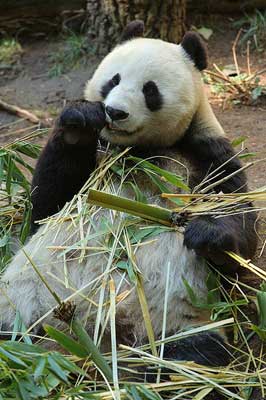
You probably
already know a bit about pandas.
They’re a type of bear found in the
bamboo forests of Western China,
where they spend most of their time
eating bamboo shoots. They’re an
endangered species, with only about
1,600 of them still alive in the wild.
Sometimes, they’re used as a symbol
for China: for example, one of the
mascots for the Beijing Olympics was a
panda.
Still, you might not know the fact that the panda has played a remarkable part in human history. Valued by kings, adventurers and environmentalists, it’s an animal that has many strange stories to its name.
From the discovery of fossils, we know that pandas once thrived over a wide area in Asia, living as far South as Vietnam and Myanmar. Later, because of changes in climate and clearing of forests by humans, they became much rarer animals.
All sorts of legends were told about these creatures. The Tibetans believed they were at first completely white, but after a girl was killed while saving them from a leopard, they rubbed black ashes on their eyes and legs to mourn her death. One Chinese scholar wrote that a tribe had trained pandas to be war animals; another scholar thought that pandas were able to eat iron.
Emperors seem to have especially valued pandas, sometimes keeping them as pets. One emperor from the Han Dynasty (206 BCE- 220 CE) was buried with a panda skull.
It was only in the 19th century that people from outside Asia got to know about the panda. The first time was in 1869, when a Christian missionary from France received the skin of a panda as a gift.
Furry Gifts
From the 1930’s to the 1950’s, China went through a particularly tough time. There was a Japanese invasion, a revolution and a famine, so many people suffered and died. Perhaps because of hunting, pandas became rarer and rarer.
A new government came to power in 1949, headed by Chairman Mao Zedong. They set up Wolong Nature Reserve, a place where pandas could live in the wild with protection from hunters and woodcutters who might want to take bamboo from the forest.
But Chairman Mao had a bigger problem. Many other countries were refusing to accept his government as the true government of China. Then, someone came up with a clever idea: just like the emperors, the new government would send gifts of pandas to other countries. The art of keeping good relationships between countries is called "diplomacy", so this practice was nicknamed "panda diplomacy".
The idea was a great success. Over the next two decades, pandas were sent to zoos in nine different countries, including USA, Russia, North Korea, France, Germany, Japan, Great Britain, Spain and Mexico, drawing crowds of eager visitors.
Eventually, the Chinese government began to realise that giving away its pandas might not be such a good thing. Pandas in zoos very rarely have cubs, and those cubs often die soon after birth. From 1984 onwards, pandas have only been lent out, not given, to foreign zoos, with a charge of US$1 million for every ten years they hold on to the animals. Any cubs born in the zoos will also be owned by China.
Meanwhile, more efforts have been made to help the pandas in the wild. More nature reserves have been set up: now there are over 40. New methods have been tried out to try and increase the number of pandas. One of the most successful is called “swap raising”. Normally, when a panda mother gives birth to twins, she only raises one cub and leaves the other to die. But if a doctor takes care of one cub and the mother takes care of the other, and they keep on swapping cubs so each baby gets some attention from the mother, both can usually grow up into healthy adults.
Today, outside of China and Hong Kong, there are only twelve zoos in the world that have pandas. But with the Internet, it’s now possible to keep watch on pandas from any place in the world. For over 2,000 years now, the humble panda has certainly played a lively part in our history. Perhaps if we do our part to save the planet, they’ll be around for another few thousand years. Who knows what strange stories will come out of that?
This article first appeared in the May-June 2008 issue of What's Up.
Re-published here in February, 2010
Still, you might not know the fact that the panda has played a remarkable part in human history. Valued by kings, adventurers and environmentalists, it’s an animal that has many strange stories to its name.
From the discovery of fossils, we know that pandas once thrived over a wide area in Asia, living as far South as Vietnam and Myanmar. Later, because of changes in climate and clearing of forests by humans, they became much rarer animals.
All sorts of legends were told about these creatures. The Tibetans believed they were at first completely white, but after a girl was killed while saving them from a leopard, they rubbed black ashes on their eyes and legs to mourn her death. One Chinese scholar wrote that a tribe had trained pandas to be war animals; another scholar thought that pandas were able to eat iron.
Emperors seem to have especially valued pandas, sometimes keeping them as pets. One emperor from the Han Dynasty (206 BCE- 220 CE) was buried with a panda skull.
It was only in the 19th century that people from outside Asia got to know about the panda. The first time was in 1869, when a Christian missionary from France received the skin of a panda as a gift.
Furry Gifts
From the 1930’s to the 1950’s, China went through a particularly tough time. There was a Japanese invasion, a revolution and a famine, so many people suffered and died. Perhaps because of hunting, pandas became rarer and rarer.
A new government came to power in 1949, headed by Chairman Mao Zedong. They set up Wolong Nature Reserve, a place where pandas could live in the wild with protection from hunters and woodcutters who might want to take bamboo from the forest.
But Chairman Mao had a bigger problem. Many other countries were refusing to accept his government as the true government of China. Then, someone came up with a clever idea: just like the emperors, the new government would send gifts of pandas to other countries. The art of keeping good relationships between countries is called "diplomacy", so this practice was nicknamed "panda diplomacy".
The idea was a great success. Over the next two decades, pandas were sent to zoos in nine different countries, including USA, Russia, North Korea, France, Germany, Japan, Great Britain, Spain and Mexico, drawing crowds of eager visitors.
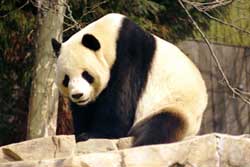
A Panda at the Smithsonian National Zoological Park in USA
Eventually, the Chinese government began to realise that giving away its pandas might not be such a good thing. Pandas in zoos very rarely have cubs, and those cubs often die soon after birth. From 1984 onwards, pandas have only been lent out, not given, to foreign zoos, with a charge of US$1 million for every ten years they hold on to the animals. Any cubs born in the zoos will also be owned by China.
Meanwhile, more efforts have been made to help the pandas in the wild. More nature reserves have been set up: now there are over 40. New methods have been tried out to try and increase the number of pandas. One of the most successful is called “swap raising”. Normally, when a panda mother gives birth to twins, she only raises one cub and leaves the other to die. But if a doctor takes care of one cub and the mother takes care of the other, and they keep on swapping cubs so each baby gets some attention from the mother, both can usually grow up into healthy adults.
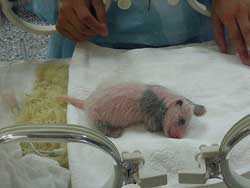
A panda cub, about one week old,
receives tender care from a vet at
Chengdu’s panda breeding centre..
Today, outside of China and Hong Kong, there are only twelve zoos in the world that have pandas. But with the Internet, it’s now possible to keep watch on pandas from any place in the world. For over 2,000 years now, the humble panda has certainly played a lively part in our history. Perhaps if we do our part to save the planet, they’ll be around for another few thousand years. Who knows what strange stories will come out of that?
This article first appeared in the May-June 2008 issue of What's Up.
Re-published here in February, 2010

